
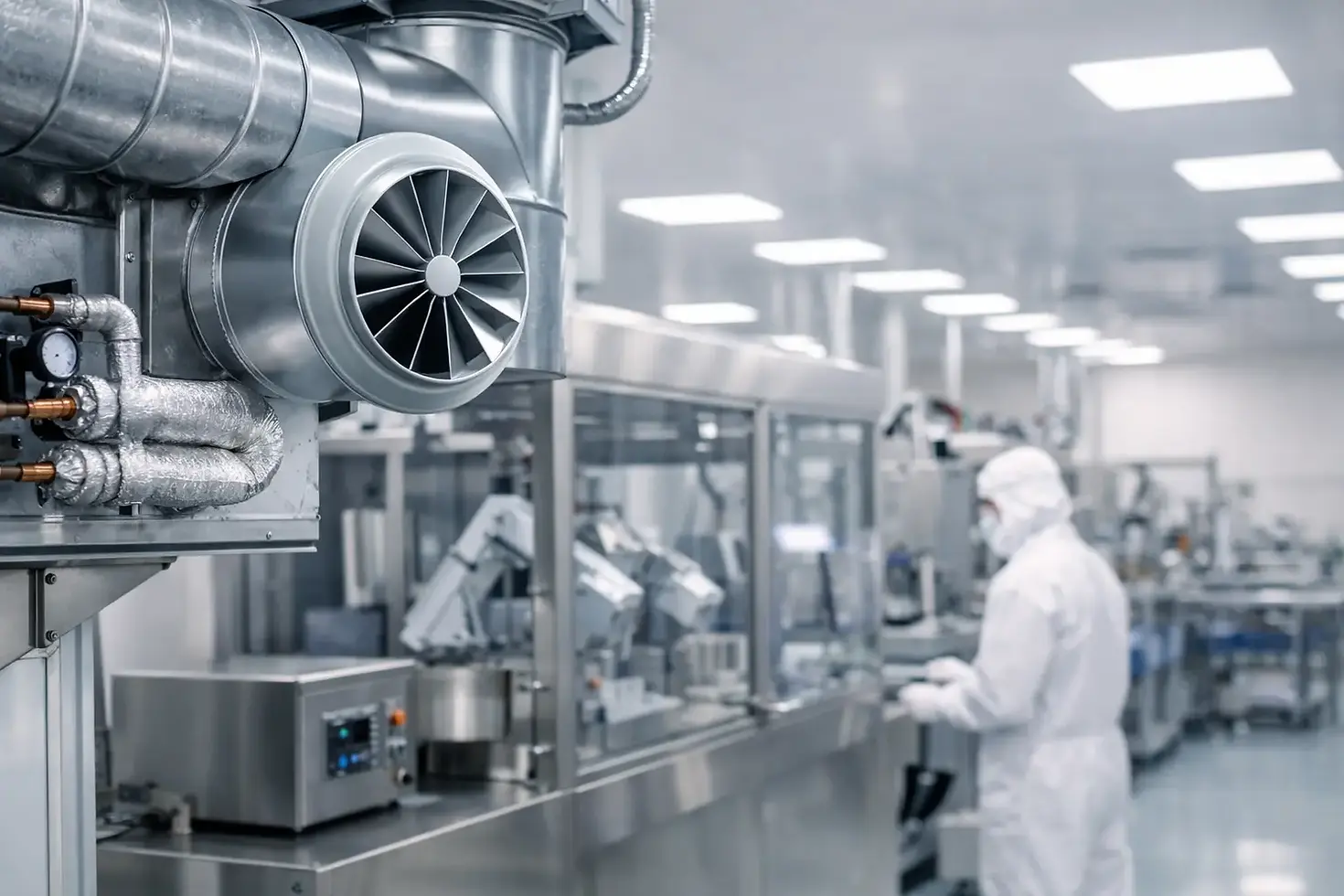
HVAC Support for Clean Manufacturing Facilities
A clean manufacturing line can be producing acceptable product at 9:00 a.m. and facing a costly hold by noon because a pressure relationship drifted, humidity rose, or a filter bank was bypassed. HVAC support for clean manufacturing is therefore not routine comfort cooling. It is an operational discipline that protects controlled conditions, product integrity, personnel safety, and production uptime.
For facility managers and operations leaders, the mechanical system must do more than maintain a temperature setpoint. It must deliver the required airflow, filtration, pressurization, ventilation, and moisture control consistently - during production, after maintenance, and when outdoor conditions change. That requires a service partner that understands both commercial HVAC equipment and the consequences of environmental variation inside critical spaces.
What HVAC Support for Clean Manufacturing Must Control
Clean manufacturing environments vary widely. A medical device assembly area, electronics production suite, pharmaceutical packaging room, and precision optics operation may have different standards and process risks. Still, each depends on controlled air conditions that ordinary commercial HVAC service may not address with enough precision.
Temperature is often the most visible requirement, but it is only one part of the system. A few degrees of drift can affect material handling, equipment performance, employee comfort, or process repeatability. Relative humidity can be equally consequential. Excess moisture may create condensation risks, interfere with sensitive components, or support microbial growth. Air that is too dry can increase static discharge and compromise electronics handling.
Pressure relationships also matter. Positive pressure helps protect a cleaner room from infiltration from adjacent spaces, while negative pressure may be required where a process needs containment. Those relationships depend on a balance between supply air, return air, exhaust air, door operation, and building leakage. A new exhaust connection, a damper adjustment, or a failed actuator can upset that balance without causing an obvious comfort complaint.
Filtration performance completes the picture. Filters must be selected, installed, sealed, and replaced according to the facility's process requirements. A filter with the wrong efficiency rating can undermine contamination control. A filter that is overloaded can restrict airflow and affect pressure control. A poorly seated filter can allow air to bypass the media entirely.
The Mechanical Systems Behind Controlled Conditions
Clean manufacturing HVAC systems commonly combine standard commercial equipment with specialized controls and air-distribution strategies. Split systems, package units, rooftop units, boilers, air handlers, makeup air systems, exhaust systems, and dedicated dehumidification equipment may all have a role. The correct arrangement depends on the facility's clean classification, process heat load, operating schedule, redundancy needs, and available infrastructure.
Rooftop units and package units can serve support spaces, offices, warehouses, and less-sensitive production areas. In controlled zones, they may be part of a larger strategy that includes terminal units, reheat, supplemental filtration, and dedicated outside-air treatment. Their condition still matters. A failed economizer damper, compromised cabinet seal, or improperly commissioned fan can introduce moisture, contaminants, or unwanted pressure changes.
Boiler operations may also be central to clean manufacturing performance. Hydronic heating and reheat systems help maintain stable discharge-air temperatures and manage humidity. When a boiler plant, circulating pump, control valve, or coil fails, the result may be a sudden inability to maintain conditions even when cooling equipment appears to be operating normally.
The controls layer connects these assets into a functioning system. Sensors, thermostats, transmitters, valves, variable-frequency drives, dampers, and building automation sequences must be accurate and coordinated. Technicians should not assume a displayed value is correct simply because it appears on a screen. Sensor calibration, control logic, physical airflow verification, and trend review are all necessary when critical conditions are in question.
Why Air Balance Cannot Be Treated as a One-Time Project
Testing, adjusting, and balancing is essential when a space is built or renovated, but clean facilities do not remain static. Filters load. Dampers wear. Fans lose performance. Process equipment is added. Production layouts change, and doors may be used differently than originally planned.
A pressure relationship that passed commissioning can gradually become unreliable. This is why maintenance planning should include periodic verification of critical airflow and pressure conditions, particularly after modifications, major repairs, or repeated alarms. The right interval depends on the process and risk profile. A space supporting highly sensitive work may need more frequent review than a controlled assembly area with broader tolerances.
Preventive Maintenance That Protects Production
Preventive maintenance in a clean manufacturing facility should be built around failure prevention, not a generic checklist. Standard tasks such as belt inspection, coil cleaning, electrical testing, drain maintenance, and lubrication remain important. But the plan must also address the parts of the system that influence controlled conditions directly.
Filter maintenance deserves particular attention. Replacement schedules should account for pressure drop, production demands, seasonal conditions, and the facility's contamination-control requirements. Replacing filters too late can reduce airflow and strain fans. Replacing them without proper containment and installation practices can introduce contaminants or leave gaps around the filter frame.
Coils, drain pans, and condensate lines also require disciplined service. Dirty coils reduce heat-transfer performance and can increase humidity-control problems. Standing water or poorly maintained drainage creates an avoidable indoor-air-quality concern. Technicians working in or near controlled areas should understand access protocols, housekeeping expectations, and the need to protect the environment during service.
A meaningful maintenance program should also verify safeties, inspect fan assemblies, evaluate motor and bearing condition, test control sequences, and document readings that reveal performance trends. Supply-air temperature alone is not enough. Depending on the space, documentation may include static pressure, filter differential pressure, relative humidity, room pressure, airflow, and equipment operating status.
Responding to Alarms Without Creating a Larger Problem
When an environmental alarm occurs, production teams need more than a quick reset. They need a clear assessment of whether the event is isolated, whether product may be affected, and what is required to restore stable operation. A reliable HVAC response begins with confirming the condition at the space, not only at the control system.
A high-humidity alarm, for example, may stem from a failed compressor, a chilled-water issue, an open outside-air damper, insufficient reheat, a dirty coil, a sensor error, or a change in exhaust airflow. Each cause requires a different corrective action. Treating the alarm as a thermostat issue can delay the real repair and extend the production risk.
Critical facilities benefit from defined escalation procedures. The maintenance team, operations contact, controls provider, and mechanical contractor should understand who is notified, what readings are collected, and when a condition warrants stopping a process or placing product on hold. This planning improves response time and prevents confusion during an active event.
Planned Upgrades Often Deliver More Than Emergency Repairs
There are times when repair is appropriate, and there are times when recurring instability points to a system limitation. Aging equipment may no longer provide the turndown, latent capacity, redundancy, or control precision the process requires. Repeated compressor failures, persistent humidity excursions, and unstable pressure control are signals worth investigating rather than simply repairing again.
Upgrades can include improved filtration housings, dedicated outdoor-air equipment, variable-speed fan control, better sensing, reheat capacity, redundant components, or revised zoning. The best solution is not always the most complex one. It depends on process tolerances, operating hours, existing equipment condition, available budget, and the cost of a production interruption.
Before selecting equipment, facilities should evaluate actual operating data and the current load profile. A unit may appear undersized during a short peak event but actually be limited by controls, airflow, maintenance condition, or a recently changed process. Precision starts with diagnosis.
Selecting a Mechanical Partner for Critical Spaces
Clean manufacturing support requires technicians who can work methodically in environments where small deviations matter. Look for a commercial HVAC provider with experience in clean rooms, laboratories, surgical suites, and other high-stakes facilities. The provider should be capable of installation, repair, controls troubleshooting, and ongoing maintenance across the full mechanical lifecycle.
Responsiveness matters, but so does follow-through. A trusted partner documents findings, explains the operational implications, identifies options, and helps facility teams plan work around production requirements. For organizations with multiple locations, consistent service standards and clear reporting become even more valuable.
Griffin Mechanical Services brings decades of hands-on expertise to commercial mechanical systems where reliability and precision are not optional. The goal is not simply to keep equipment running. It is to help maintain the environmental conditions your operation depends on.
A clean manufacturing facility is only as controlled as the systems that support it. Treat airflow, humidity, filtration, and pressure as production assets, and give them the same disciplined attention applied to the process equipment on the floor.


Comments